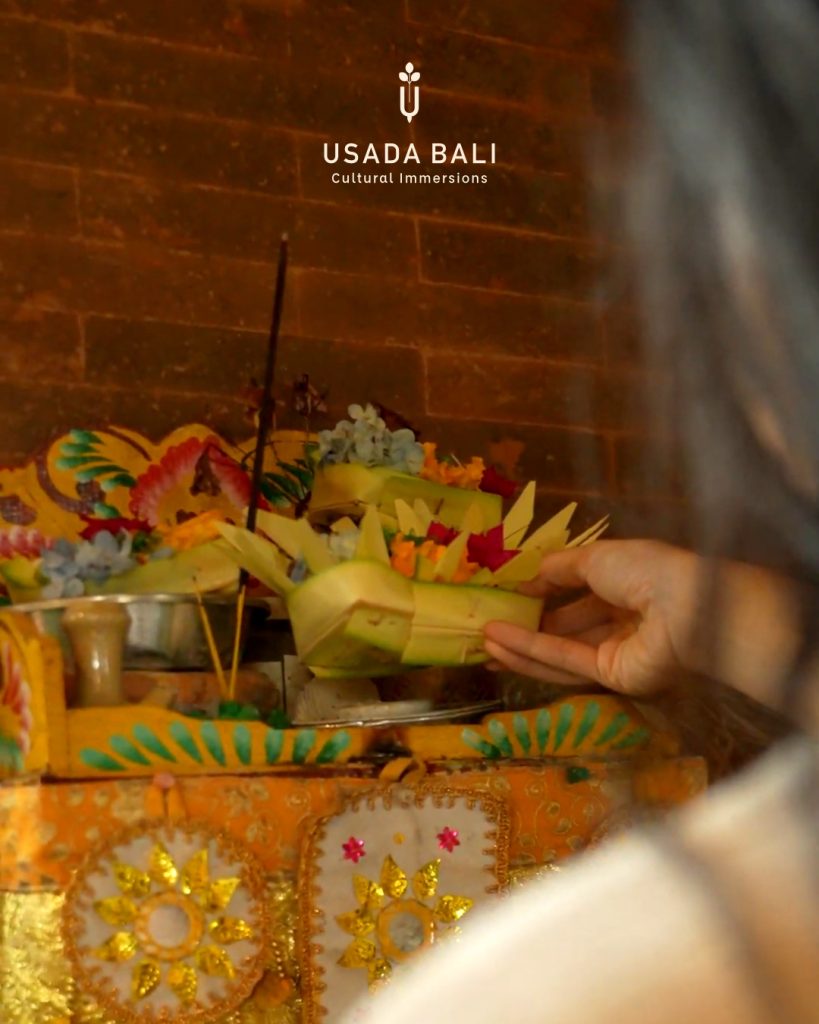
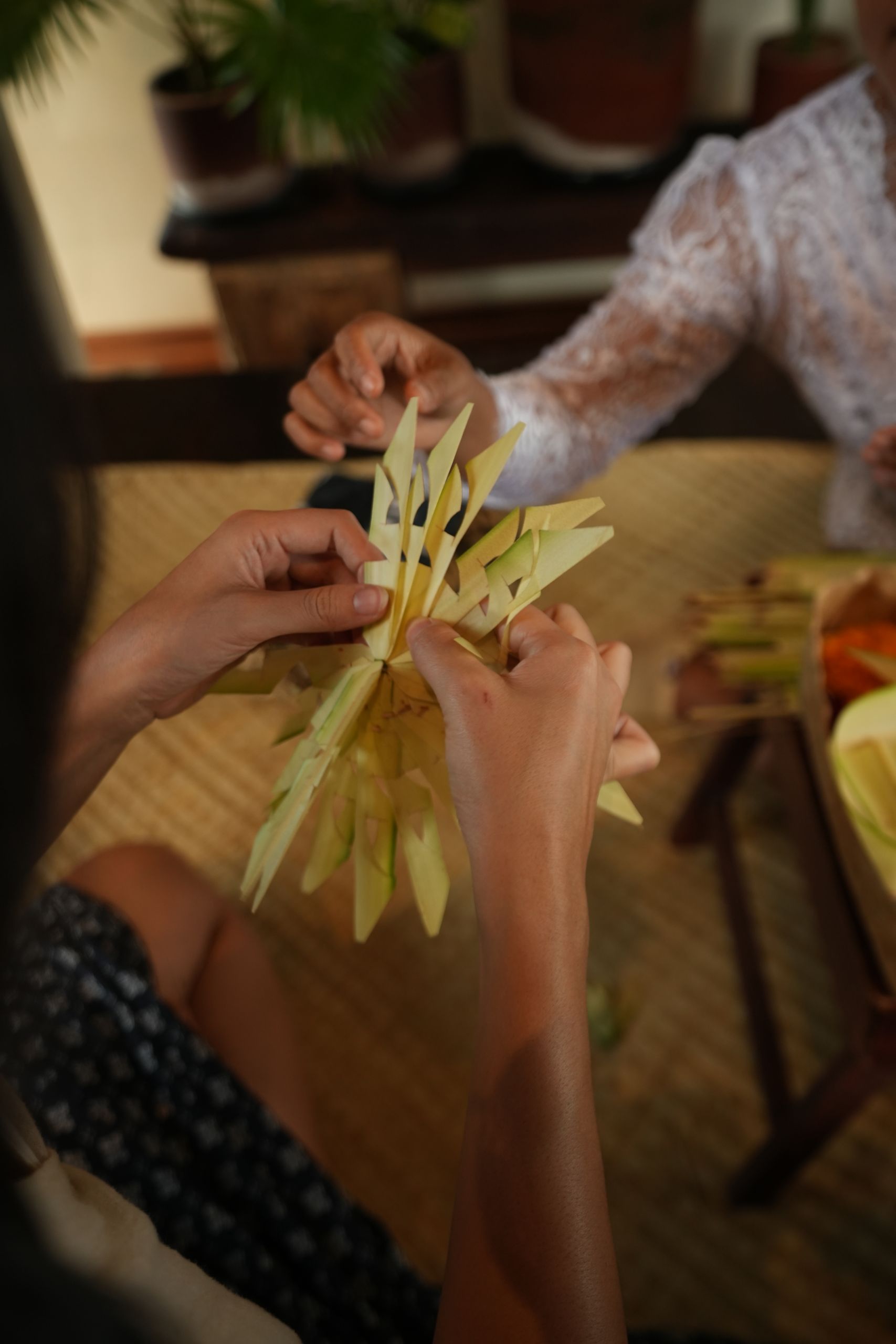
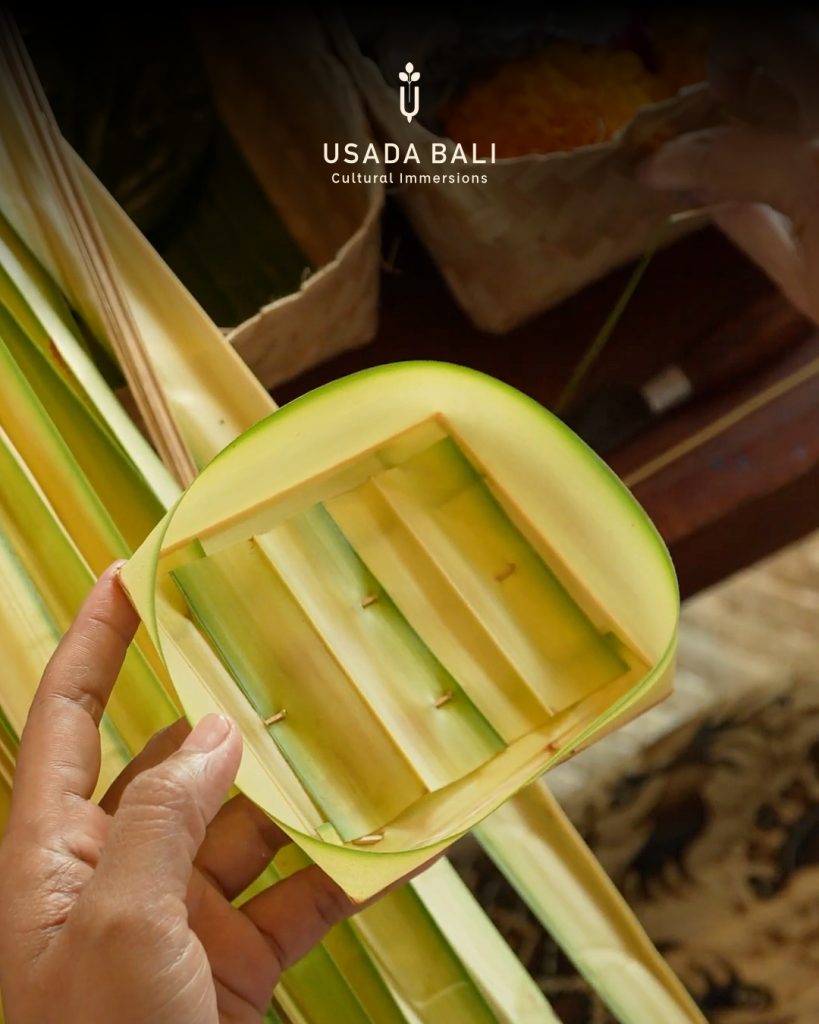
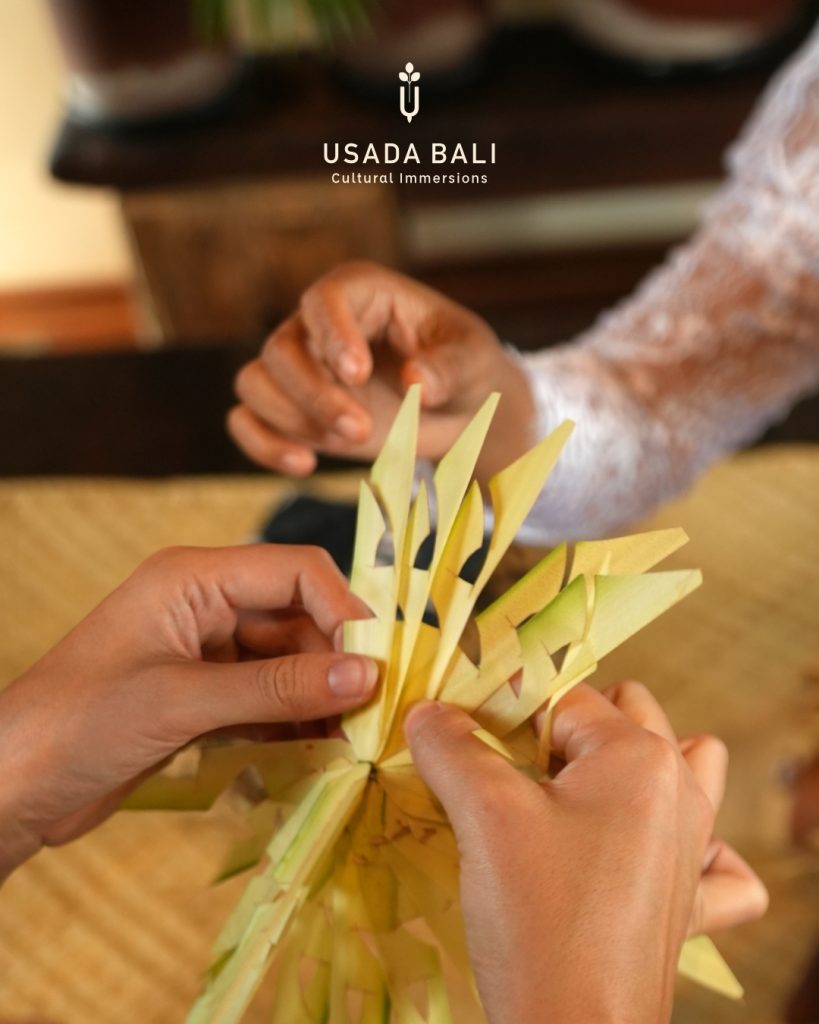
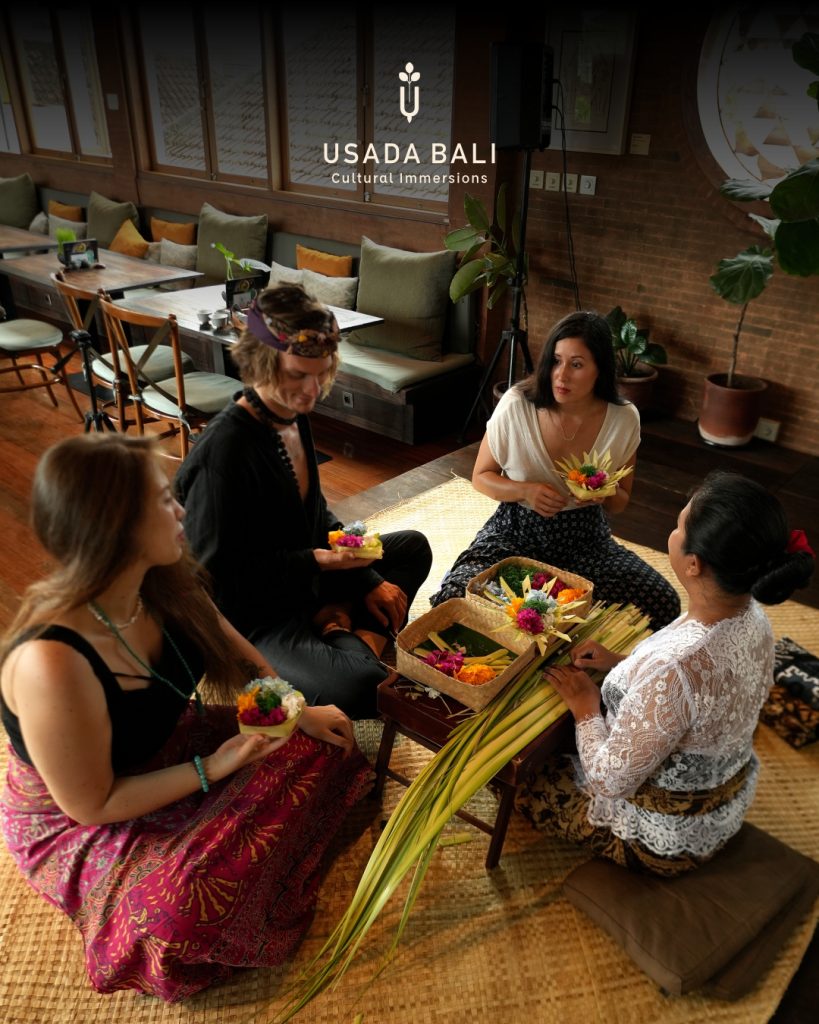
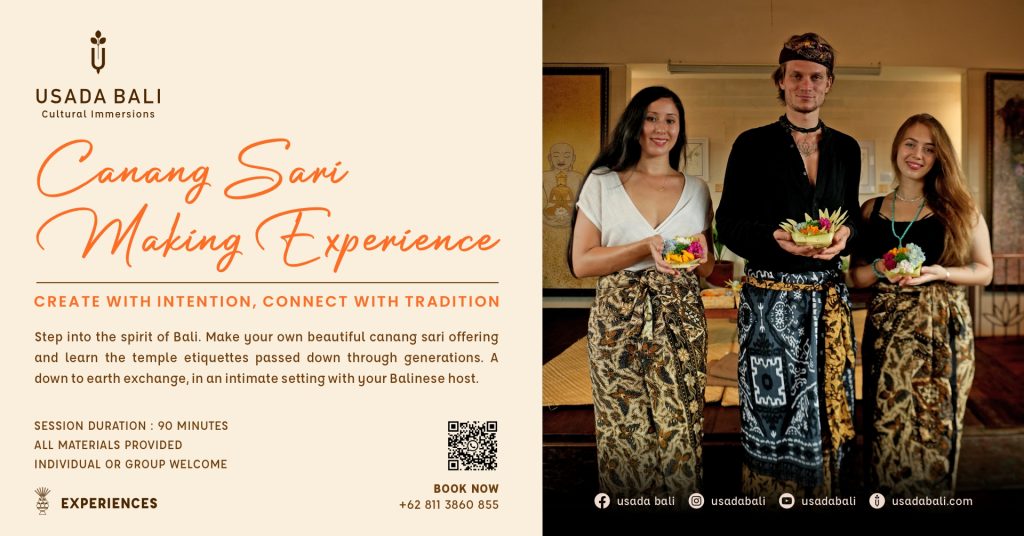
I’m sitting here with the team as we prepare the materials for our new Canang Sari Making Experience. The photoshoot and recordings took place a few weeks ago, and it was a memorable experience, even for our guest participants. We all acknowledge how often we see the canang in our daily lives here in Bali. However, the depth and vastness of its meaning are understood to varying degrees, even among Balinese. There’s the literal, almost academic definition… and then there’s the personal, intimate expression — the deepest spiritual voice we carry within us, connecting to this vessel of offering, a bridge to spirit.
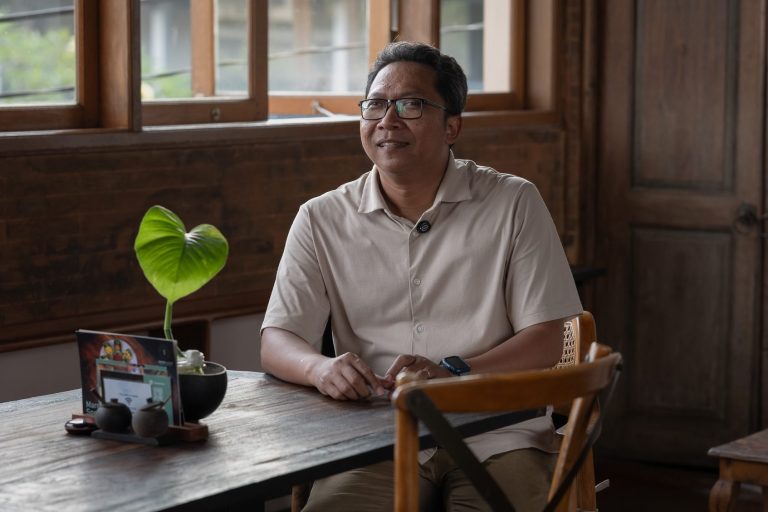
But let’s start with the general definition. The dictionary describes the canang sari as “a traditional Balinese offering, made from a small palm leaf tray filled with flowers and other symbolic items.” Sari means essence. I turn to Mita, our GM here at Usada, and ask her: “What is a canang to you, Mita?”
“Canang is one of the daily offerings we cannot forget to give, because it is an expression of gratitude and balance. We can see from all the elements we place inside the canang sari, the symbolism that keeps harmony between human beings, nature, and the divine.”
So what do we hope to impart to our guests who participate in the Canang Sari Experience?
“When people participate, we introduce our culture, something we are proud of. And beyond that, we hope guests understand the meaning, respect the process, and feel the connection behind our daily offerings.”
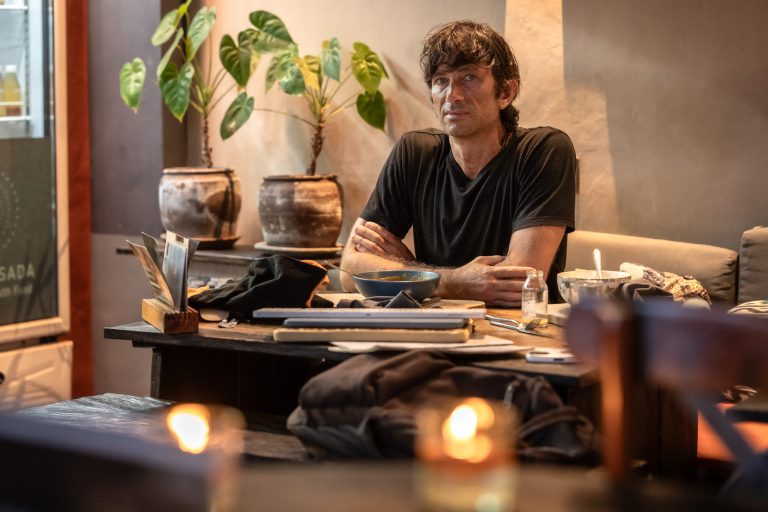
I asked Sam what he found interesting in the experience. “How complex and advanced it is. I didn’t expect the shapes, the positions, the colours, each representing so much. So many specific details. People often just buy canang and use it, but learning how intricate it really is… that surprised me.”
For me, the world of offerings is a language, perhaps even a language of gratitude. Everything contained in the offering has meaning. It comes from the earth, and we offer it back in a specific order and placement as a way of acknowledging that these gifts from nature have purpose and connect us to the divine. It’s a beautiful reminder that we are part of Nature, belonging within this system of life and creation.
In Balinese, an offering is called banten, which means “to awaken”, enten. Offerings are also called upakara, meaning “to bring closer.” Something I learned recently in a presentation by Putu Yudiantara (Beyond the Offering) is that Balinese ritual is defined through three categories: Yadnya, Puja, and Yoga. Offerings fall under Yadnya, an act of sacrificial offering rooted in ancient Vedic traditions. Yadnya, also called makarya-hayu, means “to create goodness.” This act of creating goodness through offering, that is, Yadnya. It is important for the Balinese to do this properly, to follow the right way.
It’s less about meditation or inner feeling, and more about the act itself, the doing, the making. Yet within the form of the offering lives that internal spiritual language of connecting spirit with universal oneness. These days, we move through life in such a hurry. I once heard someone say that spirit knows no hurry, that everything is perfectly timed, that we cannot rush what is. Some things require time as the price for their realisation. Perhaps offerings are like that: made with time and care, as a way to give thanks to the Universe for life and all its bounty.
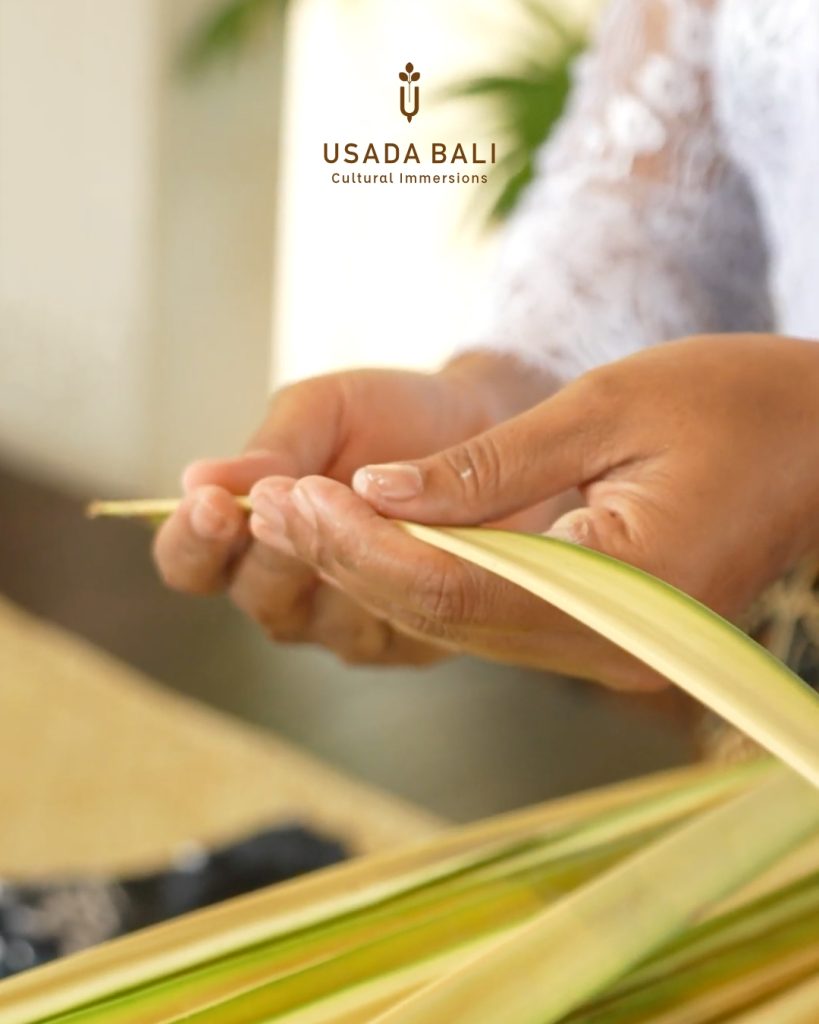
The Canang Sari Making Experience is exactly that. An opportunity to slow down. To sit together, to make together, to offer together. An intrinsically Balinese collective reality, a consciousness that comes not from watching, but from doing.